Are You a Non-U.S. IMG Starting U.S. Clinical Rotations?
If your answer is yes, then this course is for you.
Whether you are preparing for your USCE or you have already matched and are about to start residency, you are going to face one of the biggest challenges almost every non-U.S. IMG faces:
The EMR.
As a non-U.S. IMG myself, I know how difficult it can be to review a chart, extract a huge amount of messy information from the EMR, organize it, and then present the patient clearly to your attending.
There are years of notes.
Laboratory results.
Imaging.
Medications.
Specialist visits.
Emergency department records.
Hospitalizations.
Problem lists.
Old diagnoses.
New diagnoses.
And information scattered throughout the chart.
Where do I look?
What information matters?
How do I turn all of this into a clinical story?
You want to showcase your skills.
You want to show your medical knowledge.
You want to show that you care, that you are willing to learn, and that you want to improve.
You may even have an excellent USMLE score.
But unfamiliarity with the EMR — and with the U.S. healthcare system behind it — can hold you back tremendously.
If you are doing USCE before the Match, you need to perform well so you can earn a Strong Letter of Recommendation.
If you have already matched, you need these skills to perform well during residency.
Maybe you are working toward a competitive fellowship.
Maybe you want to build a strong reputation within your program.
Or maybe you simply care about being an excellent physician and want to do the best you can for your team and your patients.
You already have the medical knowledge.
You should not let the EMR hold you back from showing it.
Practice Makes Perfect, But HOW...???
Honestly, this is just one of those skills that you need to practice.
But here is the problem:
How are you going to practice it?
There is no easy way to simply try an EMR. These systems are protected by the vendors and healthcare institutions.
Some students may get EMR access and basic training before their rotation starts, but there is another problem:
There are no real patient charts for you to practice on because of HIPAA.
So most of the time, the first time a non-U.S. IMG actually gets to use an EMR and practice reviewing a chart is during real patient care.
And that is a terrible time to be learning.
If you are an IMG who just started a clinical rotation, chances are you may only get limited access through the team, and you simply will not have enough time to really practice and master chart review.
If you are a matched IMG starting residency, it is even harder.
You are reviewing charts while preparing for rounds.
You may have 6–8 patients to review.
You need to check overnight events, labs, imaging, medications, consultant notes, and everything that changed.
And guess what?
YOU DON'T HAVE THE TIME.
People will be pulling you in 10 different directions.
Rounds are coming.
Your senior needs something.
Your attending asks a question.
A nurse is calling.
A patient needs you.
And somewhere in the middle of all of that, you are supposed to somehow learn how to use the EMR efficiently.
I've been there, I know exactly that feeling.
This is the problem US EMR Mastery was created to solve!
Introducing
US EMR Mastery Course
A Simulated U.S. EMR Built for Non-U.S. IMGs
Instead of teaching EMR skills only through screenshots or lectures, I created a new simulated EMR training environment.
It uses synthetic patient cases so you can practice reviewing realistic medical charts without exposing real patient information.
The platform is not designed to copy one specific commercial EMR.
Instead, it teaches the navigation principles and clinical workflow that transfer across U.S. EMR systems.
Because the real skill is not memorizing where one button is located.
The real skill is learning:
How to EXTRACT and ORGANIZE information from EMR.
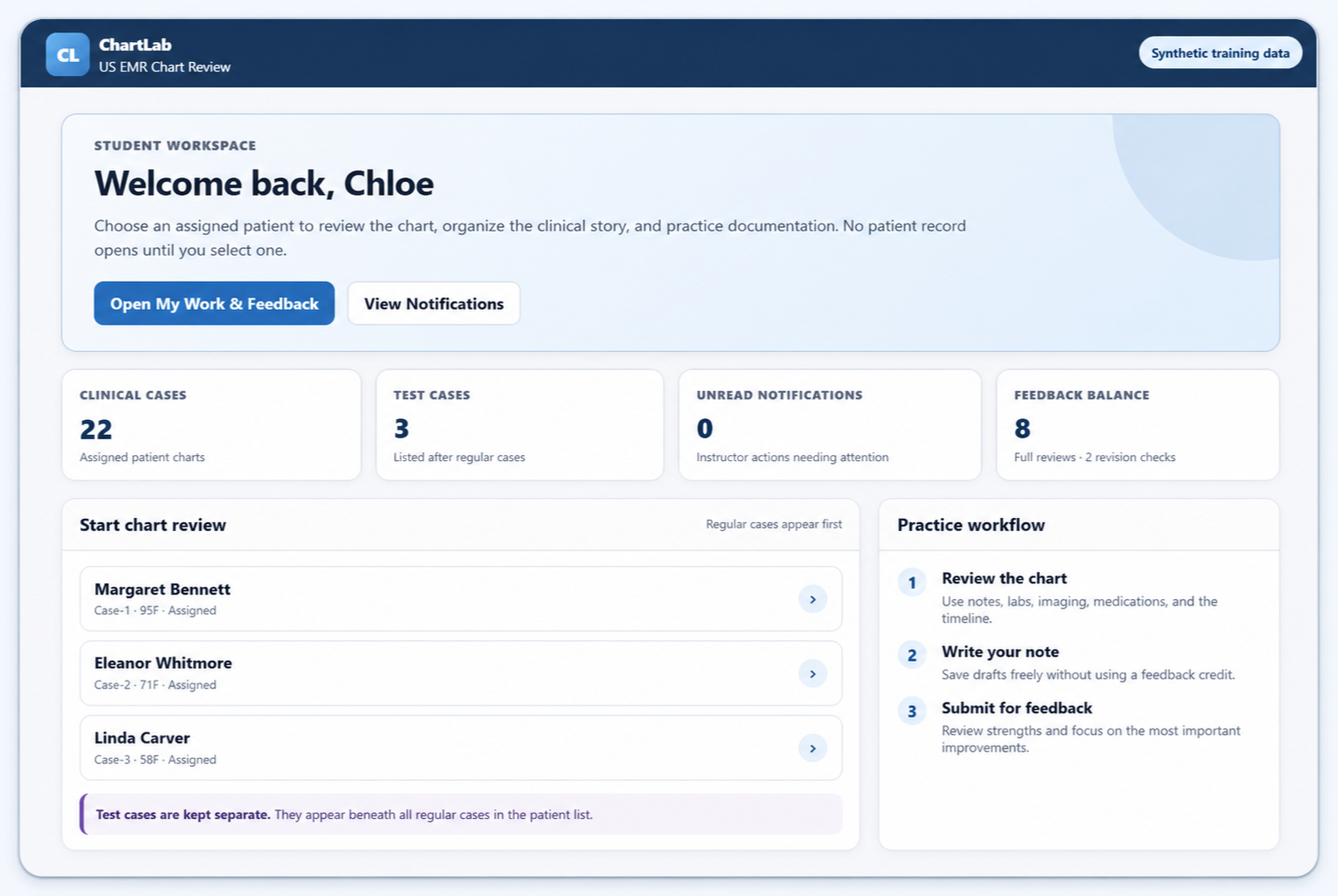
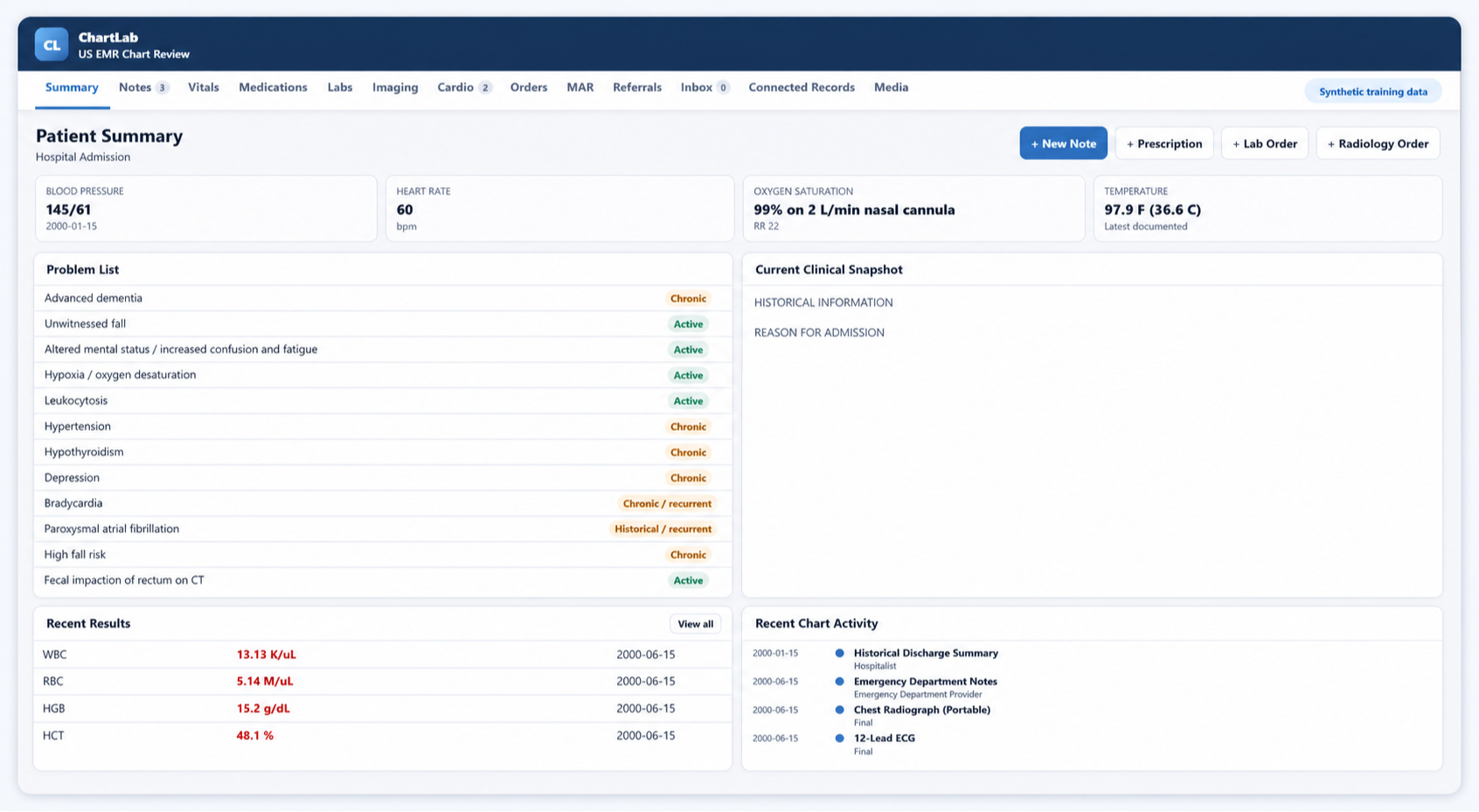
Disclaimer: All the patient's are synthetic, they are not real patient.
Think of It Like a Flight Simulator for Chart Review
Pilots do not learn to fly by only watching lectures.
They practice.
They encounter different scenarios.
They learn where to look.
They make decisions.
They repeat the process until unfamiliar situations become familiar.
EMR navigation is similar.
At first, opening a complex chart can feel overwhelming.
But after repeatedly reviewing realistic records...
you start recognizing patterns.
You know where to look.
You notice inconsistencies.
You know when something requires deeper investigation.
And you become faster at reconstructing the patient's story.
Eventually, instead of thinking:
“How do I use this EMR?”
you can focus on the question that actually matters:
“What is happening with my patient?”
The Clinical Gap
USMLE vs. Real Clinical Practice
To Understand how we can achieve mastery in using EMR, it's important to understand the difference between USMLE and Real-Life Clinical Practice in US.
There are 3 BIG DIFFERENCES
01 THE LOCATION OF INFORMATION
USMLE
Information is given to you
The facts you need are contained within one carefully constructed question stem.
Real Clinical Practice
Information must be found
It may be spread across prior and specialist notes, labs, imaging, medications, hospitalizations, emergency visits, problem lists, and years of history.
02 THE AMOUNT OF INFORMATION
USMLE
Curated and relevant
The question is organized around the important information, with limited distraction.
Real Clinical Practice
High-volume and mixed-value
The chart may contain essential facts, useful context, outdated details, and irrelevant noise. You must separate signal from noise.
03 THE CONTENT OF INFORMATION
USMLE
Written to reveal the answer
The patient history is clean, coherent, and designed to help you solve the question.
Real Clinical Practice
Fragmented and imperfect
Different writing styles, abbreviations, copied details, incomplete histories, old diagnoses, changing plans, and fragmented timelines require you to reconstruct the story.
The practical skill
In real practice, the task is not only knowing medicine—it is finding, filtering, and organizing the patient’s story.
To Master the U.S. EMR, You Also Need to Understand the U.S. Healthcare System
Imagine you are reviewing a patient's chart and you see a note written by a social worker.
If you do not understand the role of a social worker in the U.S. healthcare system, you may read the note...
but you may not know what information you are supposed to extract from it, because you don't understand US Healthcare System
And suddenly, your picture of the patient becomes incomplete.
The same thing happens when the chart mentions things such as:
Medicaid CFI
financial assistance programs
Section 8
home health services,
rehabilitation,
case management,
skilled nursing facilities,
community resources,
or other programs and services commonly used in the United States.
If you have never been exposed to these resources before, you may understand the individual words...
but still not understand what is actually happening with the patient.
That matters during chart review.
The EMR Is More Than Physician Notes
A real patient's story may be documented by many different people.
Physicians.
Nurses.
Social workers.
Case managers.
Physical therapists.
Occupational therapists.
Pharmacists.
Home health professionals.
Specialists.
And many others.
Each person may contribute a different part of the patient's story.
To understand the entire chart, you need to understand:
Who is this person?
What is their role?
Why are they involved with this patient?
What information should I look for in their note?
Only then can you correctly put the pieces together.
That Is Why U.S. Healthcare System Module Is Part of US EMR Mastery Course
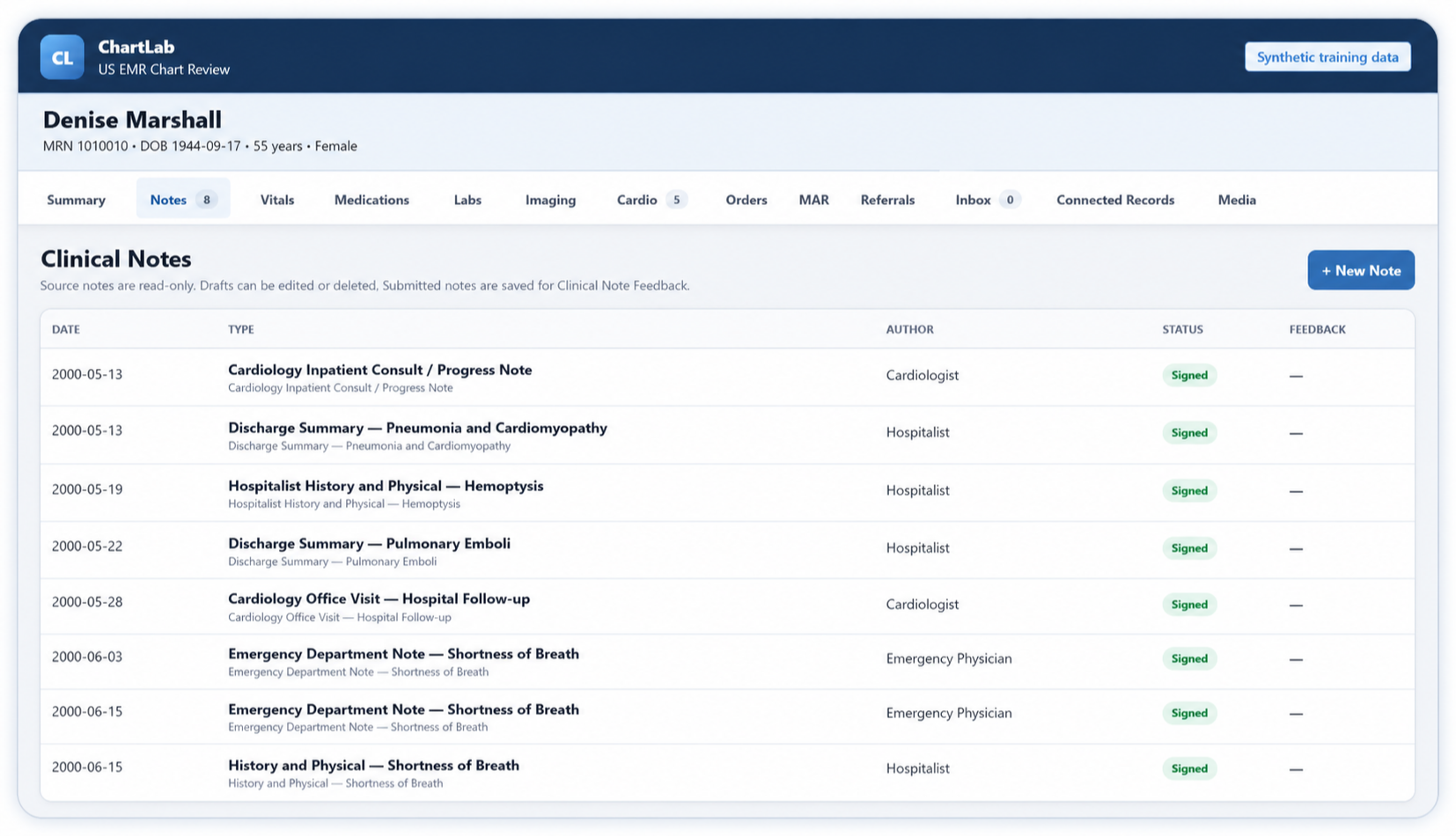
U.S. Healthcare System for Non-U.S. IMGs Module
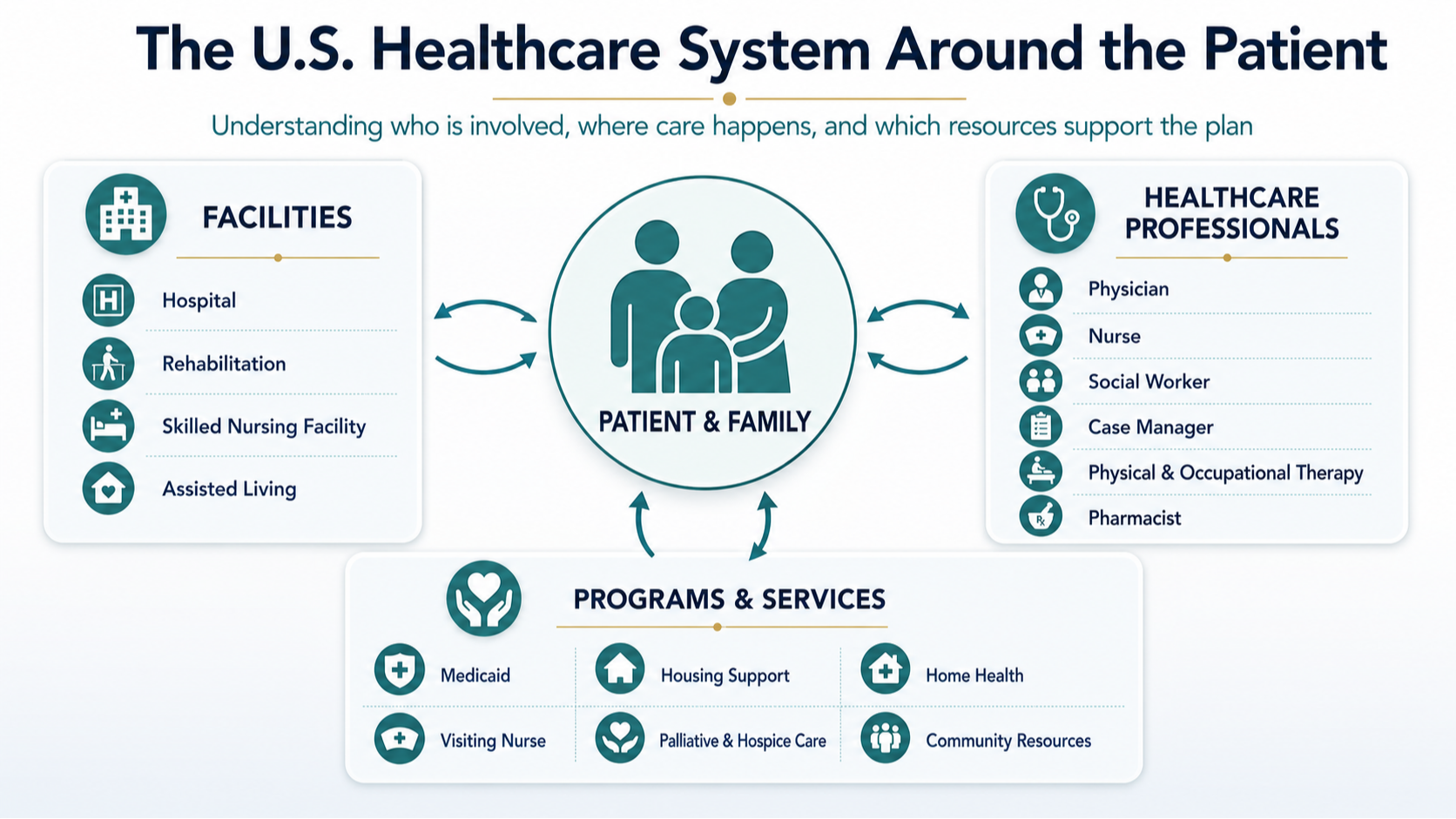
You will learn the major resources available within the U.S. healthcare system, organized into:
Facilities
Human Resources
Groups and Programs
You will learn what they are, what roles they play, and how physicians utilize them when caring for patients.
You will also receive a PDF guide explaining these concepts.
I provide you with 7 complex cases where US Healthcare system is being applied to manage those patients, these are :
Dementia, Alcoholism, Undocumented Immigrant, Severe Mental Illness, Suicidal/Homicidal, Complex Surgical Case, Complex Internal Medicine
Example:
in patient with dementia who is losing their capacity to make decision, who are the healthcare providers that we should get involved? (case manager, social worker, neurologist, etc), what facilities should we utilize? (nursing home, assisted living facility, rehab, etc) and what groups or programs are available? (visiting nurse, palliative/hospice)
how are they work together to care for this patient?
You will learn all this inside the US Healthcare system module!
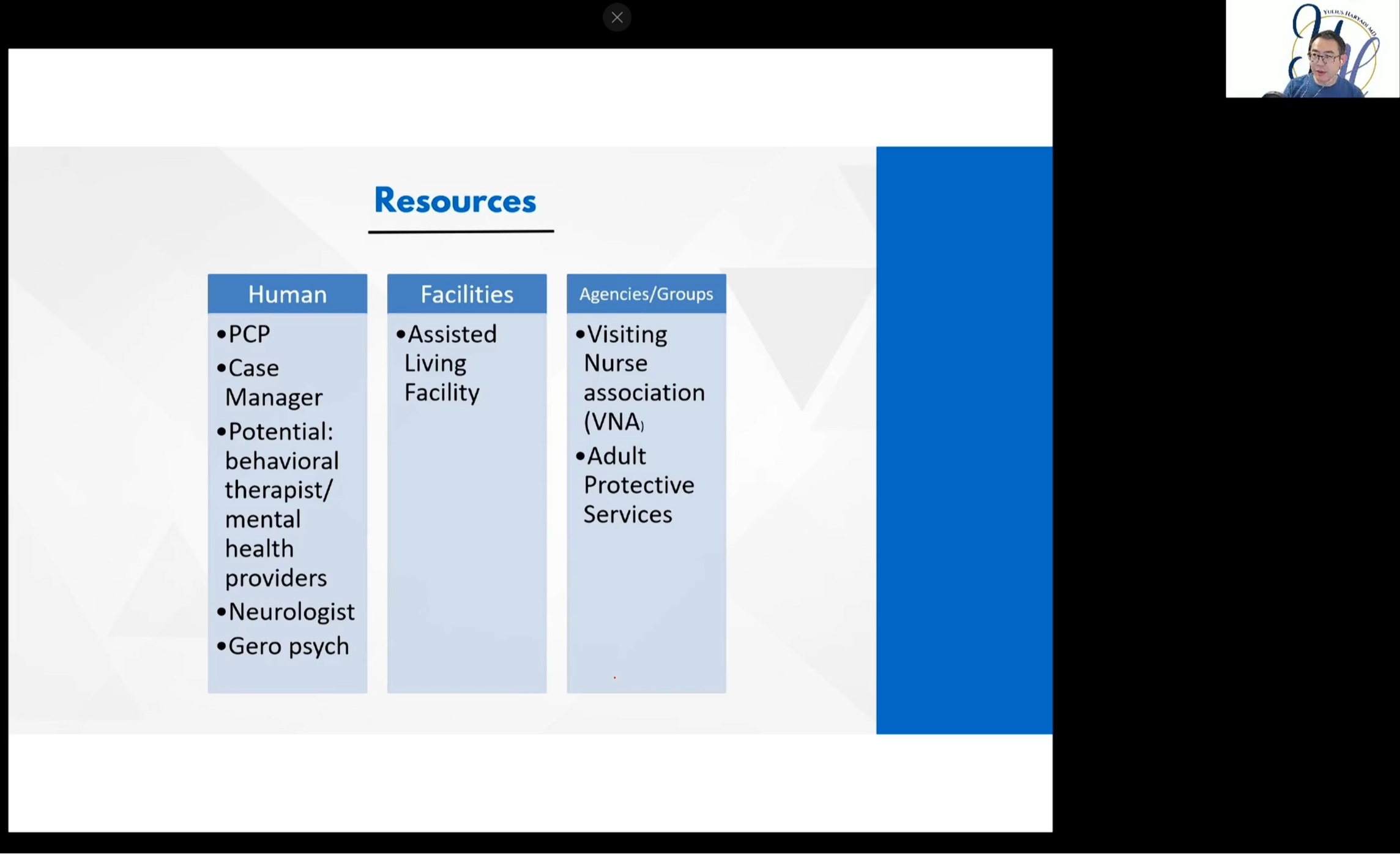
20 Clinical Training Cases — And Growing
You currently receive access to 20 cases, plus 3 examination cases.
These are the some of the topics that you will learn inside the US EMR Mastery, they are focus on bread and butter medicine, most of the case are inpatient but some are outpatient:
ACS
CHF Exacerbation
COPD exacerbation
Pneumonia
DVT/PE
Hyponatremia
Cellulitis
DKA
Acute Pancreatitis
GI Bleed
Hematuria (outpatient)
Fatique (outpatient)
Syncope (outpatient)
Diverticulitis
Complicated UTI/Urosepsis
Altered Mental Status
Stroke
Afib - New Onset
Crystal Arthritis
Alcohol intoxication and Withdrawal
Some case has:
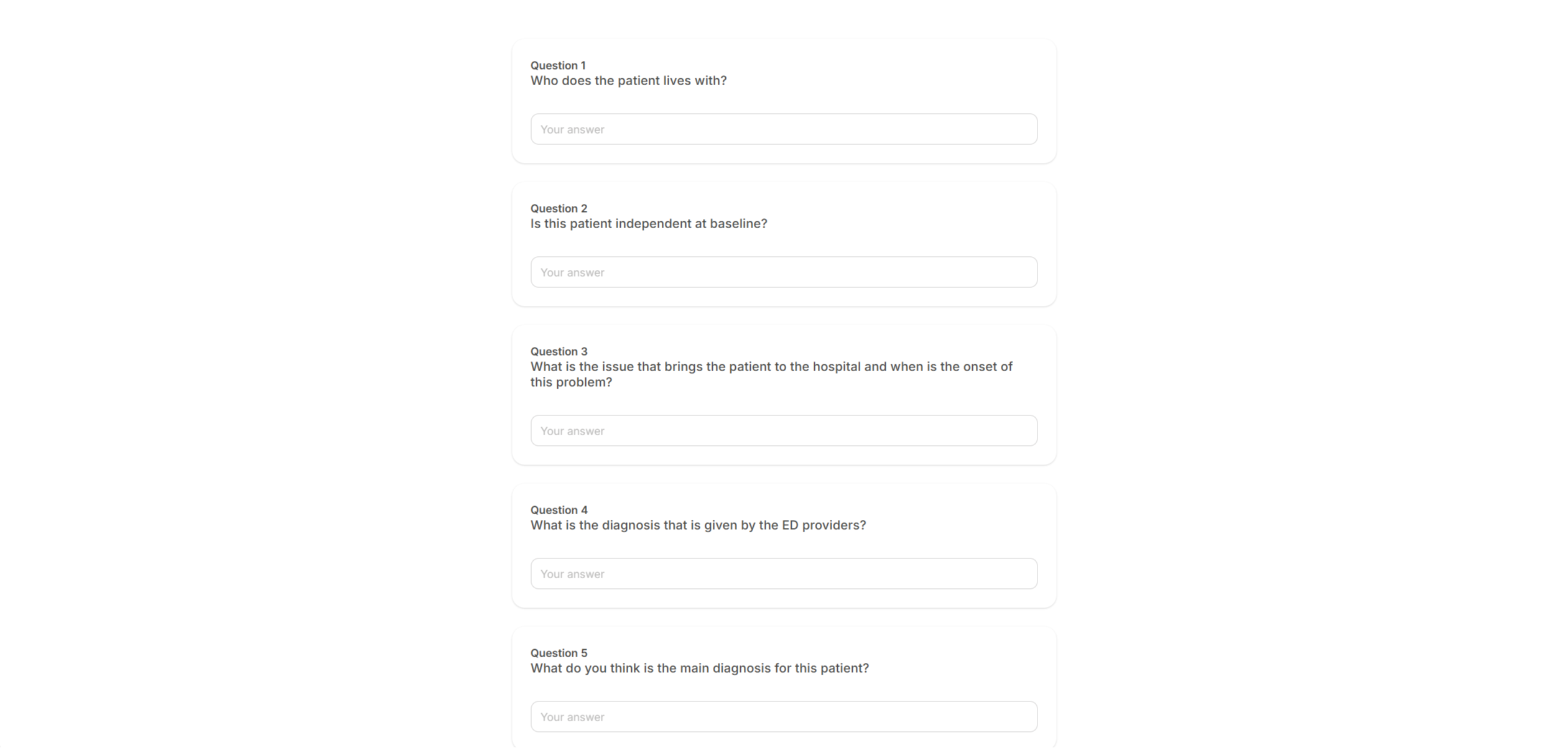
Patient Audio Encounter Simulation
Where you can listen to the conversation between the doctor and patient in US settings, so you can practice writing H&P or Office Note
Every case has:
Case Quiz
Test whether you identified and understood the important information, also your differential diagnosis and management.
Case Explanation Audio Lecture
The audio lecture reviewed the clinical knowledge, and discussed the clinical reasoning specifically to that particular case!
Example: you might get a case about CHF exacerbation. The audio lecture would review CHF topic (e.g clinical findings, diagnosis, management), then discuss about what would be the management for the patient you just reviewed (similar to morning report style in US!)
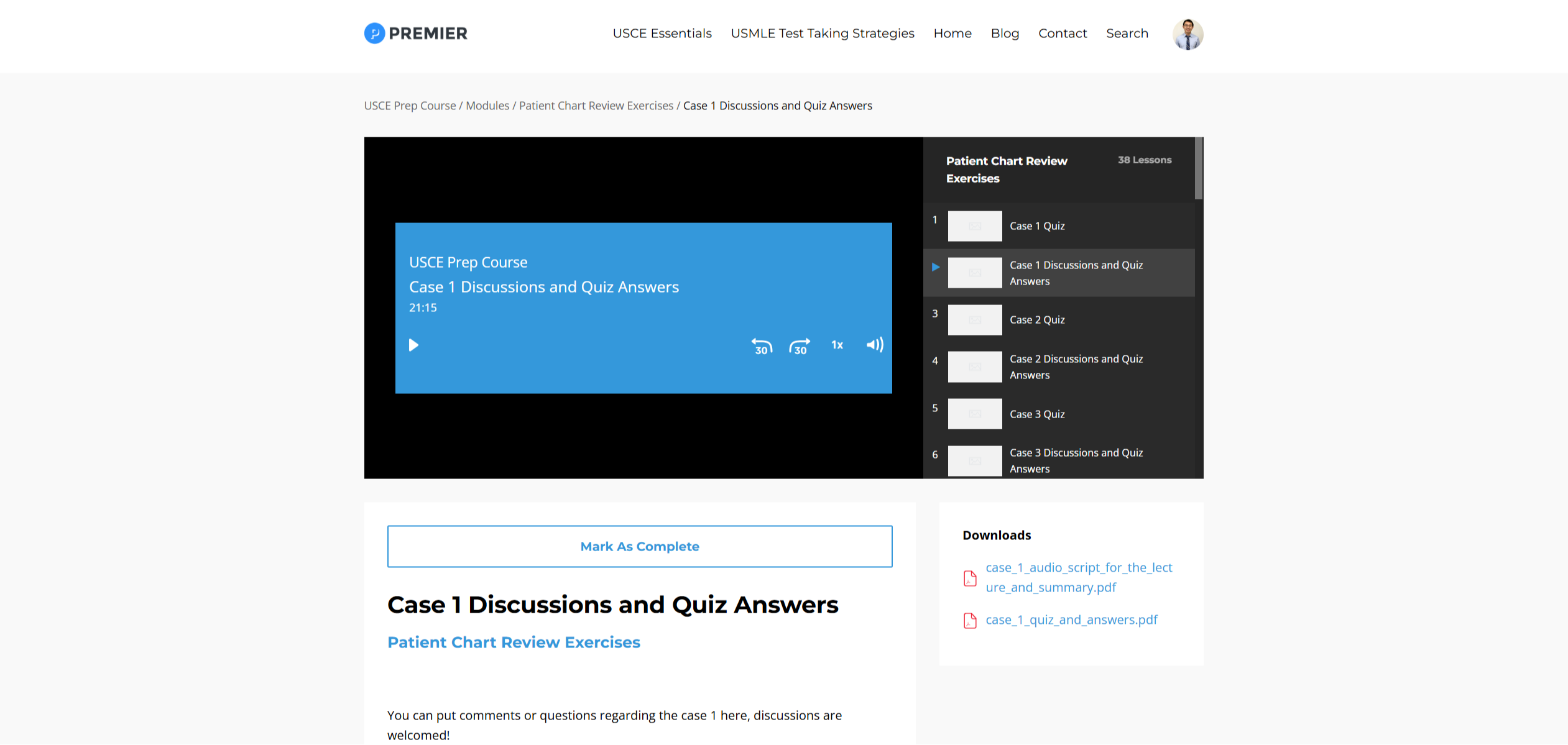
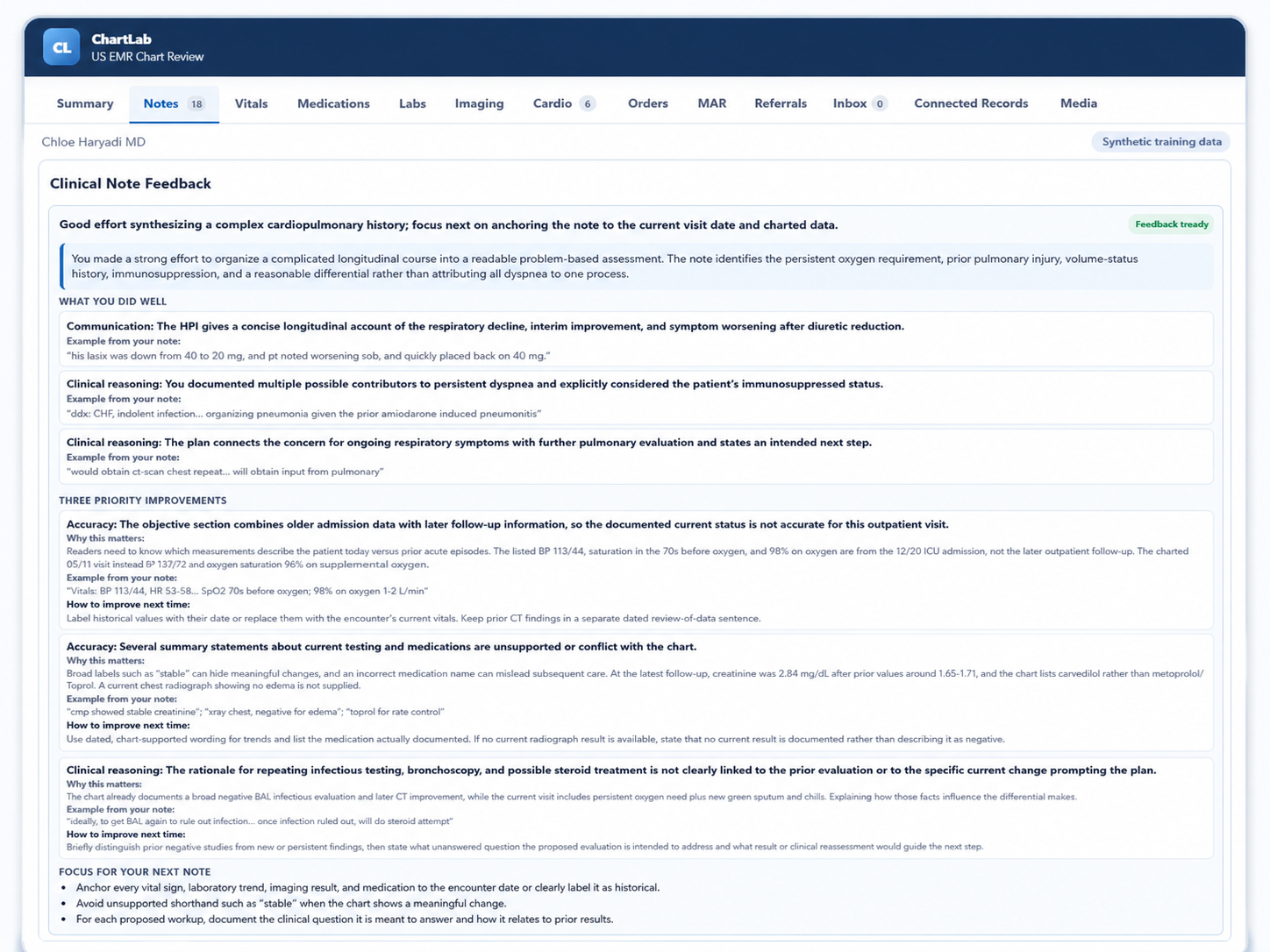
Get Feedback on Your Notes With AI
Chart review is only part of clinical performance.
Once you understand the patient, you need to communicate that information effectively.
That is why AI Note Feedback is included.
You can practice writing clinical notes based on the cases you review and receive feedback designed to help you improve areas such as:
Chronology
Did your note document a clear chronological order to helps communicate the readers?
Accuracy
Did your note correctly represent what happened?
Remember this golden rule of US medical note:
"If you do it, document it. If you didn't do it, then don't document it.
Clarity & Organization
Can you organize the raw information from the patient into a digestible, concise story so another clinician can easily understand what's going on?
Clinical Reasoning
Does your assessment connect the important findings and explain your reasoning?
Key Improvements
What are the most important changes that could make the note stronger?
Instead of simply writing a note and wondering whether it was good...
you can practice, receive feedback, improve, and try again.
What You Get With US EMR Mastery
✓ U.S. Healthcare System for Non-U.S. IMGs
Learn the healthcare resources physicians need to understand in order to manage patients through 7 sample complex cases.
✓ U.S. Healthcare System PDF Guide
Keep the material as a reference while you learn and practice.
✓ 20 Realistic EMR Cases (and GROWING!)
Practice reviewing realistic synthetic patient charts inside a simulated U.S. EMR environment.
✓ Case Quizzes
Test whether you found and understood the important information in the chart.
✓ Case Explanation Videos
Review the important findings, reasoning, and lessons after completing each training case.
✓ AI Note Feedback
Write clinical notes based on the cases and receive feedback on accuracy, organization, communication, and clinical reasoning.
✓ Lifetime Access
Practice before USCE, during your rotations, before residency, or return later whenever you want to refresh your skills.
30-Day Money Back Guarantee
I know how skeptical it is for Non-US IMG to make a money commitment, that's why to make it a no-brainer deal for you I’m giving you a 30-day 100% money-back guarantee with your purchase of US EMR Mastery Course today.
That’s right: Go through the course, watch everything, do the cases, and if you don’t feel that it's helpful for you in anyway, in the first 30 days of your purchase, send me an email and I’ll refund you immediately. No questions asked, no hard feelings.
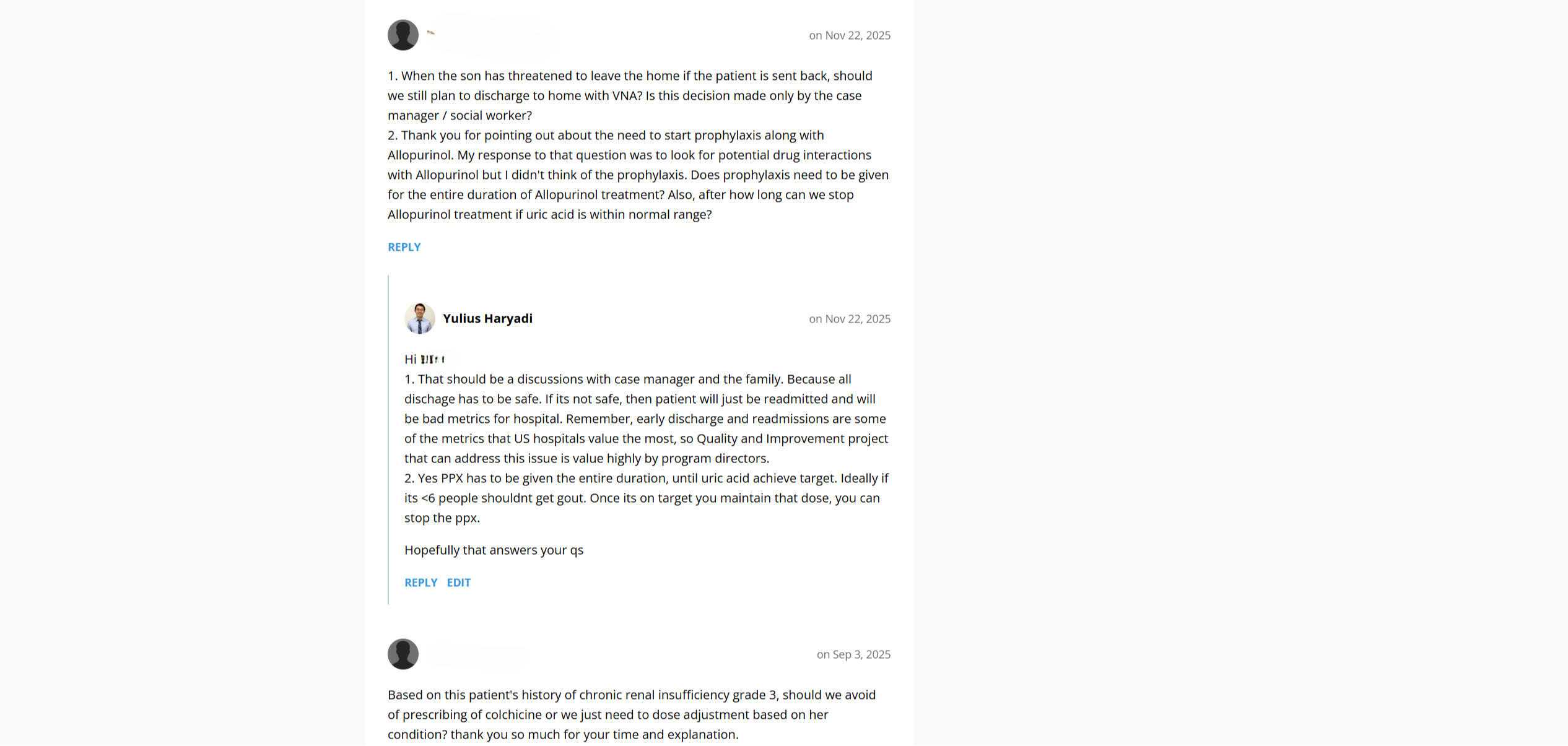
Student's Testimonials
There are 100+ Non-US IMGs who has used my EMR Mastery Course!
I am super transparent and would like you to have the best-informed decision before joining my course.
These are some of the IMG's testimonials who has joined my course, and please don't hesitate to email me if you would like more.
I will send you a screenshot of the whole students who has joined the course (with blurred/cut-out picture), then you can choose about 5 of them yourselves and I will send you their contact information after asking their permission.
This way, you are the one that choose the students you want to talk to RANDOMLY, not me. I think this is the best way to be super transparent and at the same time protect the privacy of the students, without having their inbox flooded with questions.
Singh's
Dr. Haryadi’s course has been an incredible resource, especially for someone new to the US healthcare system like me. The neuro-psychiatric cases stood out as particularly informative. These cases, including dementia and severe mental illness, highlighted the importance of understanding multidisciplinary care. I learned about essential components like MOCA and CIWA assessments, which are crucial for managing such patients in an inpatient setting. This knowledge is invaluable as it helps bridge the gap between psychiatry and internal medicine, preparing me for rotations and residency without surprises.
The webinar delivery was excellent—clear, concise, and perfectly paced. I truly appreciated the simplicity with which the information was presented, making even complex topics approachable. The Q&A session was particularly helpful in addressing my questions, and I felt fully supported throughout.
A suggestion for future modules would be to include more cases involving multidisciplinary care or basic components of other specialties relevant to internal medicine. Additionally, a video walkthrough of the US healthcare system PDF would be highly beneficial. Adding visuals like images of a Methadone clinic could further enhance understanding and retention.
Overall, this course was exactly what I was looking for. Dr. Haryadi’s ability to consolidate years of knowledge into a single course is remarkable. I’m grateful for the effort and dedication he’s put into making this learning experience so impactful."
Priyali
Dr. Haryadi’s USCE Masterclass is an unparalleled resource for IMGs navigating the complexities of the US healthcare system. Module 2 was incredibly informative and introduced many new concepts for me. Among the seven cases discussed, I found the one about undocumented immigrants to be the most insightful, especially regarding the financial aspects of their care. It provided a perspective I hadn’t encountered before and highlighted the nuances of handling such cases.
The webinar delivered a wealth of information on how cases are managed, offering practical, real-world insights. I’ve never come across any other course or resource that explains these topics with such depth and clarity. The clear and concise presentation made complex ideas accessible, even for someone unfamiliar with the US healthcare system.
One area for improvement could be the pacing, which felt slightly fast for someone like me who is still learning the hospital dynamics in the US. Adding a video walkthrough of the US healthcare system PDF, with visuals and examples, would be extremely helpful. For instance, providing a case and asking participants to think through the resources involved before a live discussion would add an interactive and practical dimension.
Overall, this session was excellent—packed with valuable knowledge and delivered with great clarity. I appreciate the effort Dr. Haryadi puts into tailoring these sessions for IMGs, consolidating years of experience into a format that’s easy to grasp and highly relevant. I look forward to more modules and would highly recommend this course to anyone preparing for USCE.
Raja
Your EMR course has been one of my favorite parts of the program. I have already been recommending it to others since I started watching the EMR videos. The cases genuinely felt like puzzles, and solving them was both challenging and fun. The new EMR is also very impressive—it looks great, is easy to use, and has so many useful features.
I am also really motivated by seeing how you are constantly working on something new, whether it is improving the platform, creating new content, or finding better ways to teach and improve the learning experience for students.
After facing so many challenges and battles throughout this journey, I can genuinely say that enrolling in your prep course was one of the best decisions I have made. Every dollar I spent on this course has been completely worth it.
I will always be grateful to you for the knowledge, guidance, encouragement, and confidence you have given me. I truly hope you and your family have a life filled with happiness, love, and peace. You are not only supporting students—you are helping many families by helping their loved ones move closer to their dreams.
Thank you once again for everything, Dr. Haryadi. I hope our paths continue to cross, and I look forward to staying connected and learning from you in the future.
Oliver
The EMR simulation app quite closely mimics the real EMR with only the slightest variations in features and interface. I practiced with the simulation app before attending my rotation, and doing so helped me adjust and learn how to use the real EMR app very quickly. By the third patient I was already comfortably navigating my way through the EMR, looking for labwork, past discharges, medication lists, notes from outside care, etc. I highly recommend to all the Non-US IMGs out there who is going for their USCE!
Why I Decided to Create US EMR Mastery Course
"Why are you slacking off? Even a medical student can do better than you!"
I still remember these words.
It was a resident who said that to me during my first USCE rotation, simply because I was accomplishing nothing.
I didn't understand anything that was happening with my patient. There were just too many notes, labs, and imaging studies for me to go through, and I couldn't even navigate through the EMR.
I felt ashamed because I came in confident, thinking that I could perform well and demonstrate my medical knowledge as someone who had scored 258 on Step 1 and 261 on Step 2 CK, and who had also been a USMLE tutor for more than 2 years at that time.
The problem was my unfamiliarity with the EMR and the U.S. healthcare system.
I do not wish this experience happened on anyone.
I want Non-US IMGs to be able to have the same playing field as AMGs during their clinical rotation, whether that's prior or after the MATCH.